
Bangladesh’s rapid urbanization and population growth are
creating an increasingly complex challenge: managing the growing volume of
municipal solid waste. Every day, large quantities of household, commercial and
institutional waste are generated across the country. When waste collection,
segregation, treatment and disposal systems cannot keep pace, the consequences
extend beyond overflowing landfills. Open dumping, water and soil pollution,
methane emissions, public-health risks and the loss of valuable resources
become interconnected urban challenges.
But what if a significant portion of this waste could become
a resource rather than a burden?
Waste-to-Energy (WtE) offers an opportunity to rethink how
Bangladesh manages its waste while supporting its growing demand for energy.
With appropriate technology, investment and environmental safeguards, waste can
contribute to a more circular and sustainable urban economy.
Understanding the Technologies: One Solution Does Not Fit
All
Waste-to-Energy is not a single technology. The most
suitable approach depends on waste composition, moisture content, calorific
value, quantity, collection systems and local environmental conditions.
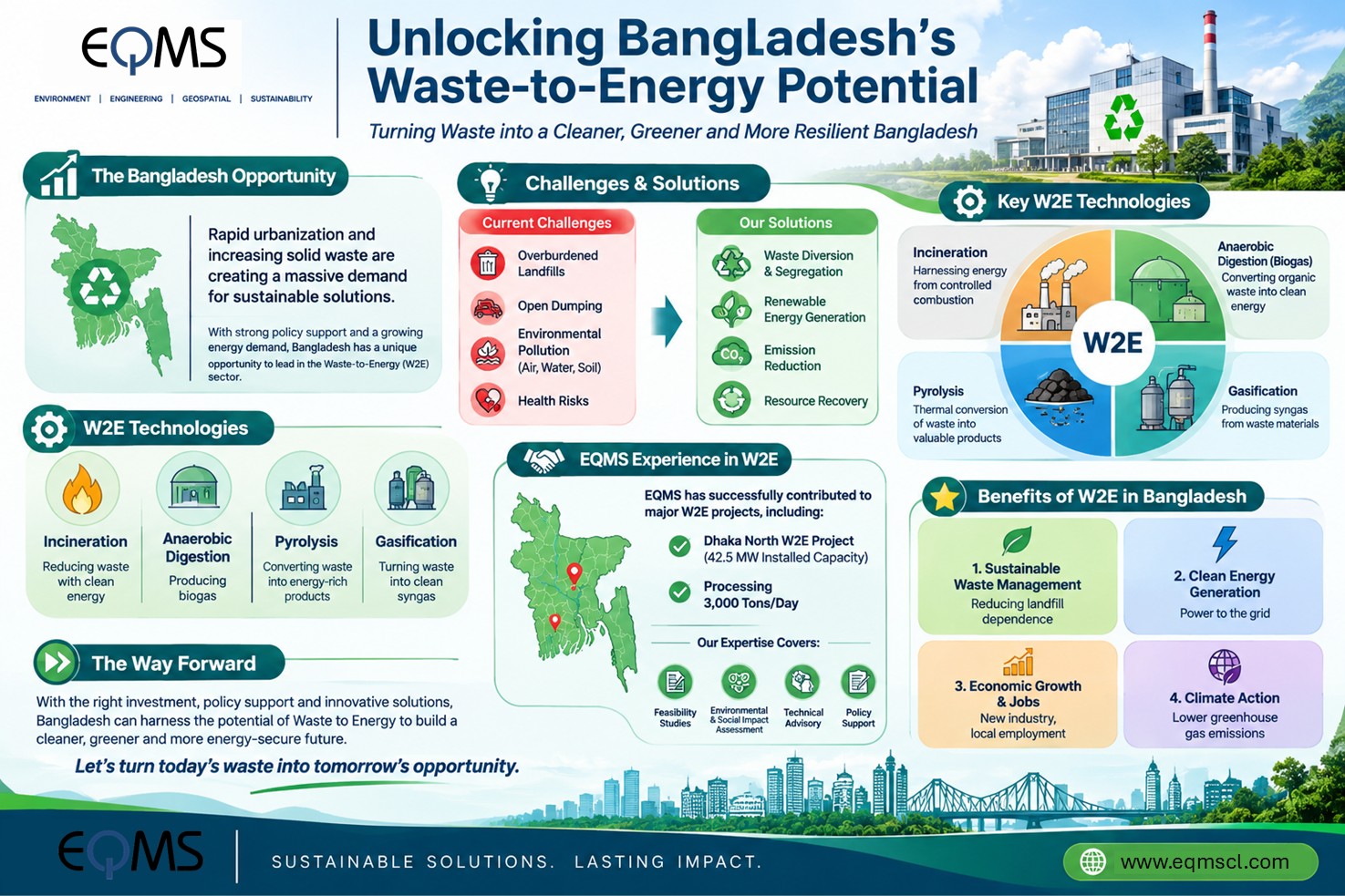
Several technologies offer different pathways:
- Incineration: Uses controlled combustion to
generate heat, which can produce steam and electricity. It requires suitable
feedstock, advanced air-pollution control and safe ash management.
- Anaerobic Digestion: Uses microorganisms to break
down biodegradable organic waste in the absence of oxygen, producing biogas
that can be used for heat or electricity. It is particularly relevant for food
and market waste.
- Refuse-Derived Fuel (RDF) and Pyrolysis: Selected
combustible waste can be processed into alternative fuel or converted into
useful products through thermal treatment under controlled conditions.
- Gasification: Converts suitable carbon-rich
materials into syngas, which can be used for energy generation or further
processing.
The selection of technology must be based on scientific
assessment rather than simply adopting a system because it has been successful
elsewhere.
This is particularly important for Bangladesh. Available
project documentation indicates that municipal waste contains a high proportion
of organic matter and has relatively high moisture content and low calorific
value. These characteristics can affect the performance and economic
feasibility of thermal technologies. Therefore, waste segregation,
preprocessing and feedstock quality assessment are essential.
aiib.org+1
Bangladesh's Opportunity: From Waste Management to Energy
Generation
Bangladesh has significant potential to explore WtE
solutions, particularly in major urban centres where waste generation is
concentrated and land for conventional disposal is increasingly constrained.
The proposed North Dhaka Waste-to-Energy Project at
Aminbazar illustrates the scale of this opportunity. The project is designed to
process approximately 3,000 tonnes of municipal solid waste per day and
generate 42.5 MW of electricity. The New Development Bank and Asian
Infrastructure Investment Bank have both published project information and
financing details.
New Development Bank+1
Beyond Dhaka, cities such as Chattogram, Gazipur,
Narayanganj, Khulna and other growing urban centres may also offer
opportunities for appropriately designed waste recovery and energy projects.
However, the potential should not be measured only by the
volume of waste generated. Each location requires an assessment of waste
quantity, composition, collection efficiency, land availability, energy demand,
transportation distance and financial viability.
Making WtE Sustainable: The Challenges We Must Address
WtE should complement—not replace—the principles of
integrated solid waste management.
Waste reduction, reuse, source segregation and recycling
must remain priorities. Recoverable materials should not be unnecessarily
diverted from recycling to energy generation.
Environmental safeguards are equally important. Thermal
facilities require effective emission-control systems, continuous monitoring,
proper management of bottom and fly ash, and compliance with applicable
environmental standards. Anaerobic digestion facilities also require
appropriate management of digestate, wastewater and odour.
Equally important are transparent project economics,
reliable waste-supply arrangements, appropriate power-purchase mechanisms,
community engagement and long-term operational capacity.
Without these foundations, a WtE facility may become an
expensive infrastructure investment rather than a sustainable solution.
EQMS: Supporting the Transition from Waste to Energy
The development of a successful WtE project requires more
than selecting a technology. It demands an integrated understanding of
environmental conditions, engineering requirements, financial feasibility,
regulatory frameworks and long-term operational considerations.
With experience in Waste-to-Energy projects, EQMS
Consulting Limited recognises the importance of multidisciplinary expertise
in advancing sustainable waste management infrastructure.
EQMS's areas of relevant support include feasibility
studies, environmental and social impact assessment (ESIA), technical advisory,
project management, and policy and planning support. By bringing these elements
together, projects can be developed with greater consideration for
environmental compliance, technical suitability and long-term sustainability.
The Way Forward
Bangladesh stands at an important point in its urban
development journey. The growing waste challenge also presents an opportunity
to recover resources, diversify energy sources, reduce pressure on landfills
and support a circular economy.
But the real measure of success will not simply be how many
megawatts of electricity a facility generates. It will be how effectively it
manages waste, protects public health, safeguards the environment and delivers
lasting economic and social benefits.
Waste is not merely something to dispose of; it is a
resource that must be managed intelligently.
With the right technology, responsible investment, strong environmental governance and multidisciplinary expertise, Bangladesh can turn today's waste challenge into tomorrow's sustainable energy opportunity.
Let's turn today's waste into tomorrow's opportunity.
Share this page via
More from Ehasan Reza